

The Man You Were Before the World Told You Who to Be | Men’s Mental Health
Ask most men who they are and they will usually tell you what they do. They will talk about their job, their responsibilities, their relationship,
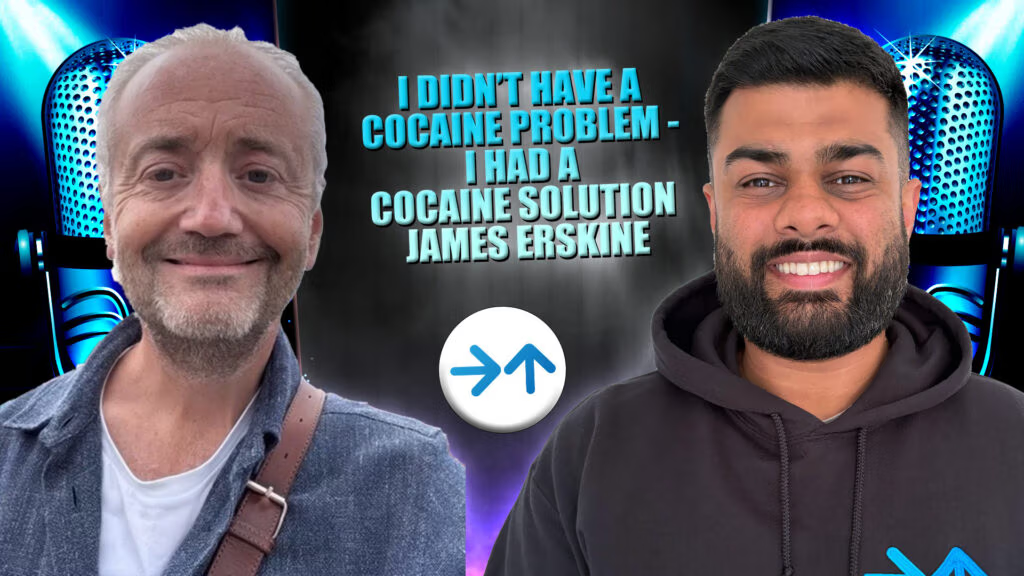
Addiction stories are often told through their darkest moments. The substance. The secrecy. The relationships pushed towards breaking point. Those moments matter but if we stop there, we miss the part that can offer the most hope: what happens next.
In episode 51 of the Onward Shift Podcast, I speak with James Erskine about cocaine addiction, identity, family and recovery. James is honest about how serious his addiction became but he does not present recovery as a tidy before-and-after story. Stopping cocaine was only the beginning. Recovery meant accepting support, rebuilding trust through actions, making amends and working out who he was without the drug.
This is James’s story. It is not a set of instructions for everybody but it is powerful evidence that change can begin even after addiction has taken someone a very long way from themselves.
Content note: This article contains frank discussion of cocaine addiction, paranoia, hearing voices, family harm and relapse risk. If cocaine is affecting your health, relationships, work or finances, the NHS explains how to get help for cocaine addiction. If somebody is in immediate danger, call 999.
James is a marketing and communications professional, podcaster, husband and father from the outside, parts of his life looked successful: he built businesses, worked with major brands and had a loving family around him. Inside, however, cocaine had gradually moved from something social to something that shaped his routines, identity, decisions and view of reality.
During our conversation, James traces that progression without trying to make it sound dramatic or glamorous. He talks about early warning signs, broken promises, people pleasing, self-worth, business pressure and the lies that addiction brought into almost every part of his life. Most importantly, he explains what recovery has required from him during the three years since he stopped using cocaine.
The discussion is not only about drugs. It is about what people use to escape, what happens when a coping mechanism becomes destructive and why removing a substance does not automatically resolve the pain beneath it. James’s recovery shows the value of professional treatment, continuing care, peer support, accountability, family conversations and the willingness to keep changing.
One sentence near the beginning of the podcast changes the way the rest of James’s story is heard:
“I don’t think I ever had a cocaine problem. I always had a cocaine solution.”
James is not denying the devastating problem cocaine became. He is explaining the function it served before everything spiralled. Cocaine filled gaps. It helped him feel more confident, more sociable, more awake or further removed from sadness. If he was tired, it appeared to provide energy. If he was happy, it seemed to intensify the feeling. If he felt low, it gave him somewhere else to go.
That is one reason addiction can be difficult to recognise early. A substance can become connected to confidence, belonging or escape before the consequences are unmistakable.
James first used cocaine around the end of university and during the early part of his career in advertising. For years, Thursday nights out, after-parties and weekends with friends gave it a setting in which it could be explained away.
But the boundaries kept moving. He once said he would never use at his wedding, then did. Cocaine followed him into marriage, parenthood and business ownership. He broke promises, then found reasons to move the line again.
James’s story challenges the stereotype that addiction must always look like somebody losing every visible part of their life at once. He was working, building businesses, presenting, solving problems and raising a family. He could sound confident and remain outwardly capable while becoming increasingly unwell.
James reflects on setting up three businesses and admits that some of the appeal came from being able to call himself an entrepreneur. When business relationships broke down and one company struggled, he saw the business’s failure as proof that he was a failure.
He describes an underlying belief that he was not good enough and did not deserve what he had. Addiction became a pursuit of evidence that this belief was true. This will be familiar to some people in high-pressure work: when identity and self-worth become inseparable from performance, every setback can feel like a verdict on the person.
Our article on running a construction business without losing yourself explores that pressure in more detail. Pressure does not automatically cause addiction but tying your value to performance can make harmful coping harder to notice.
During the final stage of his addiction, James says his cocaine use escalated to four or five grams a day. For roughly two years, he lived with severe paranoia and heard things that were not there. He repeatedly accused his wife of having an affair. When friends could not hear the conversations he believed he had recorded, he suspected they were part of the conspiracy. He could no longer trust what was real.
James once stopped for 35 days and the voices disappeared. Yet he used again to regain access to the reality he had come to know. He describes it as a “comfort blanket of razor blades”: terrifying, but familiar.
This section is difficult to hear, particularly when James says, “I nearly capsized this family.” His daughter became sensitive to conflict and raised voices. His son understood far more about the drug use than James had realised. His wife had lived through accusations, secrecy and a prolonged loss of the man she knew.
The NHS guidance on cocaine says somebody does not have to use every day to be addicted. The point to seek help is when the drug is causing harm, not when nothing remains.
The turning point was not a sudden moment of perfect acceptance. James did not enter treatment full of hope and certainty. He went reluctantly.
At a family gathering, his sister found cocaine in his bag. James had promised that if this happened again, he would go to rehab. He now had to keep that commitment.
He spent six weeks at Harmony Clinic in South Africa. His days involved demanding group work and sessions on self-worth, behaviour and recovery.
He arrived still convinced his wife was having an affair. As he retold his life story in treatment, he began to recognise that what he had believed with certainty had not happened.
Residential treatment created distance from cocaine and gave him time to face the truth but James believes he could have relapsed quickly if support had ended when he returned to London. Rehab opened the door; it did not complete the work.
After returning home, James joined the Start2Stop Evening Programme. He attended on Tuesday and Thursday evenings and Saturday mornings while also returning to work. The programme gave him continued structure through group sessions and recovery practices but its greatest value was connection.
Back in London, James needed people who understood what it was like to return to ordinary responsibilities while trying to live differently. Start2Stop gave him a local community and helped bridge the gap between treatment and everyday life. Recovery had to work around the same city, family, workplace, bills and memories.
The NHS explains that treatment for cocaine addiction can include specialist talking therapies, couples therapy and structured incentives, with plans tailored to the individual. It also notes that mutual-aid groups can be useful for some people. There is no single route that everybody must follow, and James repeats that point throughout our conversation.
James initially resisted the idea that recovery needed to remain part of his life. He wanted to get better but also believed he should be able to do it and move on.
After the evening programme, Narcotics Anonymous became what James calls the “drumbeat” of his recovery. At the time of recording, he normally attended around four meetings each week.
What helped was being with people who did not need addiction explained. During a period when work pressure left him feeling closer to relapse, James realised that a lifelong friend would care deeply, but somebody in recovery would understand the urge without first asking why. Meetings also gave him sponsorship, friendship and a regular hour in which his phone was off and his attention was with the group.
He is clear that 12-step recovery is not the only valid path. His advice is to explore what is available and continue with what genuinely helps. His recovery is personal, not a formula.
For anyone wanting to understand the fellowship James discusses, the UK Narcotics Anonymous helpline is open from 10am to midnight, seven days a week, on 0300 999 1212.
One of the most moving parts of the podcast is James’s discussion of integrity. During addiction, a lie about cocaine made other parts of life dishonest too. A trip to a petrol station was not always what he said it was. Money had not always been spent where he claimed. Secrecy entered everyday moments until his family could no longer rely on his word.
Recovery had to involve more than saying sorry. James agreed to regular drug testing and took part in monthly family calls with his wife and siblings. Those conversations allowed relatives to ask questions and express anger. They also gave the discussion boundaries: people deserved honesty, but recovery could not consume every family interaction.
He and his wife attended couples therapy, and he made direct, amends to his children. None of this erased what happened. James recognises that scars remain across the family.
What changed was the evidence his children began to receive. They spent more time with him and confided in him. His daughter suggested that he might be ready to drive her again after he had stopped driving because he did not trust himself to keep his children safe. The comment brought him to tears. It was not really about the car; it was evidence that trust was returning.
His family did not have to forget. James had to become reliable often enough, for long enough, that a different relationship could grow.
When cocaine disappeared, James faced a difficult question: who was he without it?
The drug had been present for so much of his adult life that its absence exposed uncertainty about his tastes and identity. Even theatre had to be examined. Did he attend because a performance moved him, or because he liked being seen as somebody who went? James began asking whether his choices reflected him or the person he performed for others.
He moved from entrepreneurship into employment, where clear responsibilities brought a different kind of structure.
Finding an authentic self did not mean creating a grand new identity. It meant living closer to values he could name: kindness, support, optimism, collaboration and compassion. It meant learning that pleasing somebody is not the same as people pleasing. Helping can be generous; abandoning your own values and limits to earn validation is something else.
At around 1:01:29 in the episode, James gives his clearest description of what recovery means to him:
“Recovery is abstinence plus change.”
Stopping cocaine was essential for James but abstinence alone would not teach him to set boundaries, tell the truth, accept an ordinary day, respond differently to rejection or understand the beliefs driving his self-sabotage.
The “change” has included therapy, meetings, sponsorship, amends, accountability and examining his motives. It has also meant becoming more compassionate and interrupting his old instinct to treat every slight as proof that the world was against him.
James also separates guilt from shame. Guilt can recognise, “I did something harmful.” Shame says, “I am a harmful person.” Recovery asks him to take responsibility without building a permanent identity out of his worst actions.
James holds onto the idea that a person may not be responsible for having an addiction but they are responsible for their recovery. Responsibility has not meant doing it alone. It has meant accepting help, turning up and staying honest.
James had a home, career and loving family while his addiction became life-threatening. If a substance is affecting work, money, health or relationships, that is enough reason to contact a GP or local drug treatment service.
Residential treatment mattered, but continuing care helped James after coming home. Recovery planning must account for work, family pressure, loneliness and old routines.
Family and friends can be supportive, but peers may understand urges and relapse risk differently. Meetings and sponsorship gave James people he could contact without explaining the basics.
One apology cannot carry years of dishonesty. James used testing, planned conversations, therapy, amends and everyday reliability, while accepting that recovery set no deadline for his family’s hurt.
James has learned to value hobbies without monetising them. His picture of happiness is simple: an audiobook, his children in the pool and his wife beside him. It could be Babbacombe rather than Barbados. Being present is the point.
The latest official figures show why honest conversations about cocaine cannot be reduced to scare stories. The Office for National Statistics reported that 2.1% of people aged 16 to 59 in England and Wales had used powder cocaine in the year ending March 2025. Separately, 1,279 deaths involving cocaine were registered in 2024, the thirteenth consecutive annual rise, according to the ONS drug-poisoning data.
Those figures give scale, but they cannot show what it is like for a child to notice a parent changing or for somebody to earn back one small piece of trust. James’s career, home and intelligence did not make him immune, and his story gives the statistics a human shape.
His story shows that accountability and hope can coexist. We do not have to minimise the damage to believe somebody can change.
At Onward Shift, our role is not to tell people that one form of recovery is right for everyone. It is to make honest conversations easier to find and help people take a next step.
The Onward Shift Podcast gives people space to talk about addiction, mental health, family, work and recovery without polishing away the difficult parts. James’s episode sits alongside other lived-experience conversations, including our discussion of addiction, culture and real talk.
If the conversation has brought up something personal, our support for people page can help you explore Onward Shift’s counselling, coaching, community events and free resources. Addiction treatment itself should be sought through an appropriate NHS or specialist drug service; our purpose here is to help make the first conversation feel possible and to remind you that support exists.
James’s story does not end with him becoming the person he was before cocaine. Recovery has asked him to become more honest, boundaried and compassionate. At the time of our conversation, he had reached three years without cocaine and called it the greatest achievement of his life.
In the beginning, he stayed away from the drug for his wife and children because he did not yet believe he was worth doing it for himself. Around nine months into recovery, that began to change. He slowly moved himself from fourth place in the list of people worth saving.
Recovery did not begin with perfect self-belief. James borrowed purpose from the people he loved until he could begin to find his own.
The signs of recovery are not only tests, meetings or years. They are conversations with his children, the trust of his wife and the ability to say no. James can feel guilt without accepting shame’s claim that he is permanently bad.
Recovery, in James’s story, is not perfection. It is truth, connection and change repeated often enough to create a new life and the freedom to be okay.
If you prefer listening over reading, you can hear the full conversation on the Onward Shift Podcast.
 Listen to the episode here:
Listening in your van, on-site or on a walk can sometimes land harder than words on a screen.

Linkedin – https://www.linkedin.com/in/jameserskine/

Ask most men who they are and they will usually tell you what they do. They will talk about their job, their responsibilities, their relationship,

You start a project expecting pressure. The programme is tight, several trades are working on top of one another and the client wants answers quickly.
Workplace safety is often viewed in terms of compliance and statistics. However, behind every workplace accident is a human story often one of pain, perseverance

The Conversation Men Are Still Avoiding Let’s be honest. When most men hear the word therapy, they don’t immediately think, “That sounds like a good

Why Inclusion Is Non-Negotiable in Construction The UK construction sector is a powerhouse: over 2 million people employed and around 7% of national GDP generated.
To every construction worker reading this, whether you’re on the tools, managing a site, working nights, running a gang, leading a project, supervising a team
If you’re feeling overwhelmed or need someone to talk to, there are organisations that offer free, confidential support for mental health challenges, especially for professionals in high stress industries like construction and engineering. Here are some options available:
Provides a 24/7 confidential listening service for anyone struggling with their mental health or in distress.
A free and confidential text-based crisis support service available 24/7.
The Lighthouse Construction Industry Charity provides vital support to construction workers and their families, offering financial assistance, mental health support, and occupational health advice.
Mates in Mind works to improve mental health awareness within the construction sector. They provide training and resources to help businesses and workers address mental health challenges.
B&CE’s Construction Worker Helpline offers free support and guidance for industry workers facing financial difficulties, stress, or personal challenges. Available from 8am-8pm, 7 days a week.
Provides confidential advice and financial assistance for people working in the electrical industry.
The Rainy Day Trust provides financial assistance and support to those working in the home improvement, construction, and allied trades industries.
CRASH helps homelessness charities and hospices by providing construction-related assistance, offering expertise and materials for vital building projects.
This organisation helps young people discover career opportunities in the construction industry, breaking down stereotypes and offering pathways into the trade.
Offers emotional support and guidance for anyone affected by bereavement.
Provides 24/7 support for individuals struggling with gambling-related issues.
At AA, alcoholics help each other. We will support you. You are not alone. Together, we find strength and hope. You are one step away.
A free listening service for individuals experiencing suicidal thoughts, open from 6pm to midnight daily.
A helpline offering support and information to LGBTQIA+ individuals on topics like mental health, relationships, and identity.
Provides young people with advice and support on topics such as mental health, finances, relationships, and homelessness.
The construction industry can be both rewarding and challenging but no one should have to face difficulties alone. Whether you need financial help, mental health support or career guidance, these organisations are here to assist you. If you or someone you know is struggling, don’t hesitate to reach out. If you found this list helpful, consider sharing it with colleagues or on social media to spread awareness. Let’s build a stronger, healthier construction industry together!
Helping construction, one conversation at a time.
Helping construction, one conversation at a time.
We use cookies to make our website work properly, improve performance and personalise your experience. You can accept all cookies or manage your preferences.